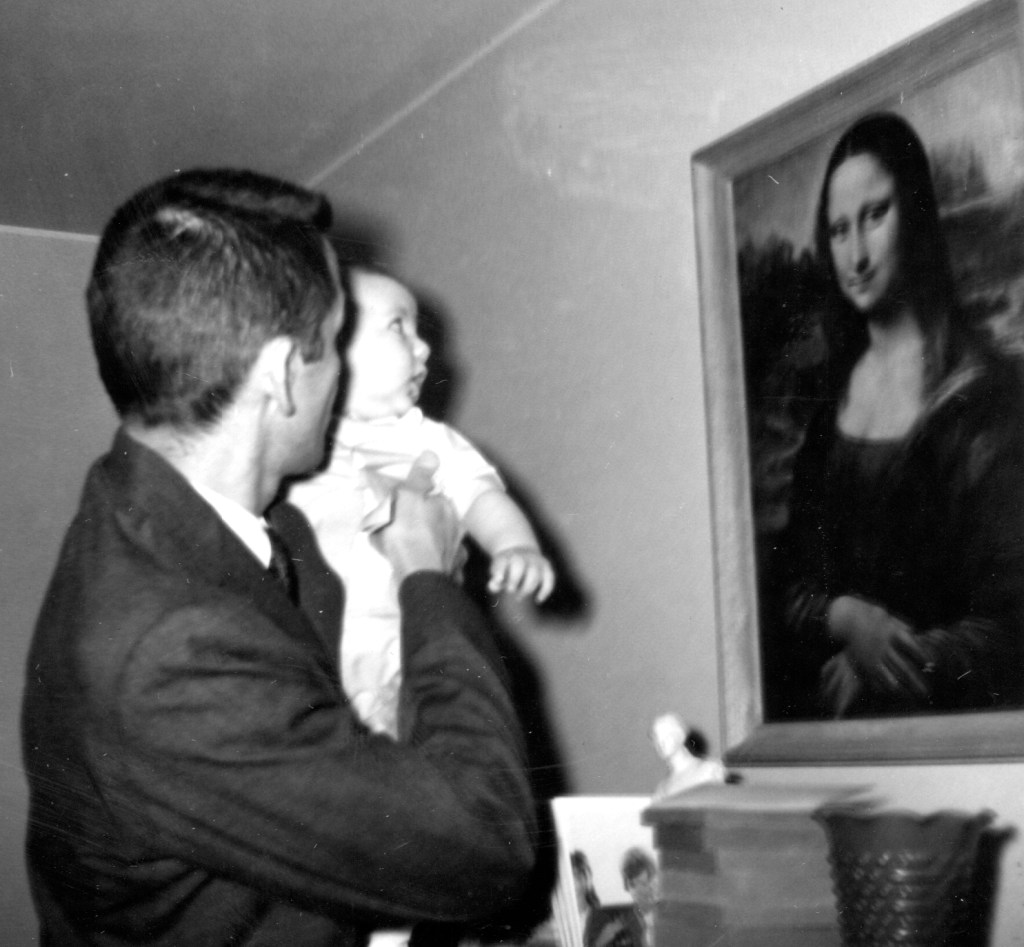
Father and The Lady

Interstate 17, Anthem, Arizona

October 9, 2009

6:17 PM

“Your Dad just passed.”

“Oh, Mom… I’m so sorry.  I’m on my way there now.  I thought… I thought he had more time.  I thought…”

“I felt his last breath.  I held his hand.  I…”  She couldn’t talk anymore. 

“I’ll call people.  You try to get some rest.  Who’s there with you now?”

“Marie Beth got here right after it happened.”

“She’ll take good care of you.  I’ll be there in a couple of hours.”

“Sheldon and Jan know.  They’re coming.  Sheldon was at a football game.”

“It’s okay, Mom.  We still have each other.  We still have family.  We’ll get through this together.  It’s what we do.”

There was silence, and just a brief sob on the other end of the phone.

“You lie down Mom.  Embee will take care of you.  We’re all coming, Mom.  You’re not alone.  Okay?”

The phone clicked.  The roaring of the road was cold.  Horace’s vision blurred a bit, and he took a deep breath.  “I have to be strong now.  Mom will be coming apart when I get there.  I have to help her through this.”  He gave instructions to his phone to call his best friend.  He would make calls for most of the trip between Anthem and Flagstaff, spreading the news of his father’s demise across the country. 
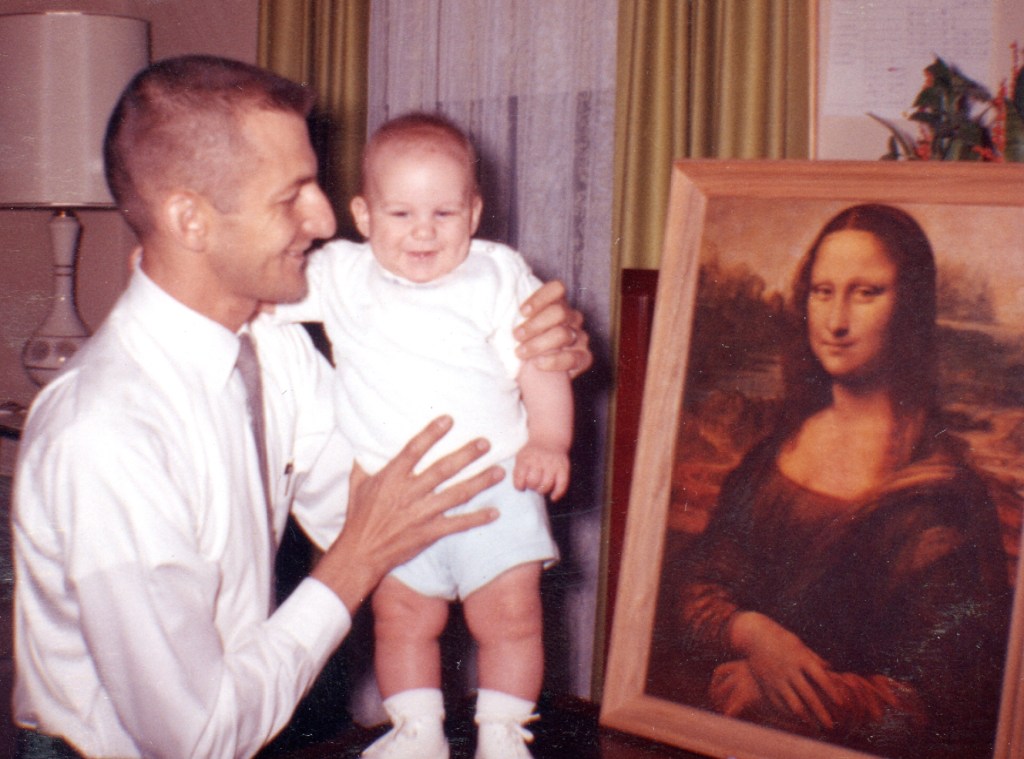
Henderson, Nebraska

January 12, 1964

6:23 PM

“Lay dee,” said the infant Horace.

Hal was holding Horace lovingly in his thin arms.  “You want to go see The Lady?”  He walked past Marie, and into the living room.

“If he wants to see his Mom,” said Owen Leal, Horace’s grandfather, “you just walked right past her.”

“No,” said Marie.  “I’m Mama.  Lady is The Mona Lisa.”

Hal stood next to the painting, and Horace began to wave.  “She’s a nice lady, isn’t she?”

Horace giggled, and he put his index finger on her lips. 

“She has a pretty smile, doesn’t she?”  Marie asked.

Horace began to dance in his father’s arms, bouncing up and down. 

“I’ll get it,” said Marie, and she went to the record player, and dropped the needle on “On The Trail” from “The Grand Canyon Suite” by Ferde Grofe.   She picked up the camera next to the turntable, and she returned to her husband and son. 

Horace grinned, jumped up and down some more, and pointed at the painting.  “Lay Dee!”

Marie took the picture.

“You’re making an art lover of that boy,” said Owen.  “Good for you, Hal.”

Horace began to wave his hands back and forth, and he tilted his head back.

“Oh, no!” whispered Owen.  “Are the demons returning?”

“No, Dad, not this time.”  Marie shot Hal a glance that told him to let it go.  “He’s conducting.  He’s seen his brother, Sheldon, doing that when we play Beethoven.  Sheldon has decided he will be the next Leonard Bernstein.”

“Is he still having as many possessions?”

Hal was grinning at Horace.  “Yeah, Pastor Leal, he’s still having seizures.  We’re going to another specialist next month after I get paid.”

“You know you’re wasting your money.  I could do an exorcism.  We don’t even need to go to the church.  I could do it here for you at no—”

“Thank you, Pastor, but I believe we’re going to go with the doctors.”

“You’re not rich folks.  You don’t make enough teaching those high school classes to be wastin’ money on what doesn’t work.  You’ve been to seven doctors already, and they haven’t fixed it.  God doesn’t need money.  All he needs is your faith and someone who is ready to remove the demons from little Horace’s soul.”

“He had one this morning right after he drank some orange juice.  I wonder if that’s connected somehow.”  Marie’s face was troubled.

“He’s also had seizures when waking up from his naps, when eating Gerber baby food, after bowel movements, and before them.  Any of those could be causes, but they don’t all line up.  So far, just about the only thing that doesn’t seem to set them off is the Mona Lisa and Music.

Interstate 17

October 9, 2009

6:59 PM

Nat King Cole was singing on the radio as Horace hung up the last phone call.

Many dreams have been brought to your doorstep
They just lie there and they die there
Are you warm, are you real, Mona Lisa?
Or just a cold and lonely lovely work of art?

He had told his best friend, who cried, although Horace had maintained his composure.  He was all but clinical when he told her.  He was surprised by Monica’s reaction.  She’d only met Hal twice.  Why would this news hit her so hard?  Horace reminded himself, once again, he didn’t understand people.

He was gaining strength with every mile.  He was remembering how, less than a week ago, his sister had screamed at his mother because Marie had neglected to keep Jan up to date on Hal’s condition.  He could see vividly in his mind Marie falling apart.  Her knees had buckled, and Horace had caught her and helped her to the couch.  When Horace asked her to knock it off, Jan turned on Horace with even more ferocity.  He had finally called his brother, Sheldon, to calm Jan down. 

Marie was going to need all his help now.  She would require all his strength.  He was going to be there for her.  He was going to be her comfort and her fortitude.  That’s what he kept repeating to himself.  Comfort and Fortitude.  Just get Mom through this night. 

It wasn’t as though no one had seen it coming. 

Anthem Elementary School

September 20, 2009

9:23 AM

“All right,” said Horace to the eager faced fifth graders.  “What do we know?”

“We know the bed was bolted to the floor,” shouted Yoli, a girl not prone to raising her hand.

“Okay, good.  Now, what does that mean about the bed?”

“It means Julia couldn’t move it, no matter what.”  This was Armando, a kid two sizes too big to be in fifth grade. 

“Hmm,” mused Horace.  “I wonder why Roylott wouldn’t want her to move the bed.  Is there anything around the bed that could be relevant?”

There was silence while the faces of 28 kids contorted in thought.  Horace ambled over toward the vent, and inconspicuously put his hand on it.

“The vent!  The vent!  It’s over the bed!”  These were random shouts scattered through the room.

“So, Amanda, what would be so important about the bed being near the vent?”

“Maybe…” and Amanda put her hand on her chin, as she had seen her teacher do so many times.  “Maybe it was poison gas that he pumped through the vent?”

“How would he keep the gas from killing him?  His room is on the other side of the vent.”

Again there was silence.  After a moment, Jake, a boy two size too small to be a fifth grader, suggested, “Maybe that’s what that metallic clanging was?  It was some kind of special machine that he puts against the vent, and it pushes gas into the room without letting it go through to his side of the room.”

“I like the way you think.  That’s certainly possible.  What do we know about the inside of Dr. Roylott’s room?”

“There’s a safe in there,” said Amanda.

“Yes, there is.  It’s sitting on a table.  Is there anything on the safe?”

Pages began flipping at desks throughout the room.  “A saucer of milk.”  This was the first time Christina had spoken in two days. 

Horace smiled broadly.  “Way to go, Christina!”

“So, he drinks milk,” said Armando sarcastically.  “Big deal.”

“Do you drink your milk from a saucer?” Horace asked him, while shooting him a glare that made it clear we don’t step on Christina when she finally says something.

“I’ve never been kidnapped by aliens.”

The class laughed.

“A saucer is a really shallow bowl.  You can’t, for example, have your cereal in one.  And the only way to drink out of it is—”

“Licking it!” shouted Yoli.  “Like a cat.”

“Do you suppose he keeps his cat in that safe?”

“That would be weird,” Yoli replied.

“Roylott killed his daughter.  We already know he’s weird.”  Amanda looked up at Horace.  “Still, what’s the point of keeping a cat in a safe?  Why not just let it wander around like everyone else does?”

“Good question.  Was there anything else on the safe?”

“What’s a lash?” asked Christina.

“It’s the way Doyle spelled leash.  You know, like you use for a dog?  But there was something weird about the leash.  Do you remember what was weird about it?”

“It’s tied in a weird little loop.”

“Nice, Antonio.  It is.  Why would you tie a leash like that do you think?”

“For something with a really small neck,” called out David, who came to class stoned at least twice a week.

“Sounds less like a cat all the time.  What else could it be?”

Horace was thinking three questions ahead to the bell pull that rang nothing but ran from the vent to the pillow on the bed when his cell phone rang.  Horace was startled, and he pulled it out of his pocket, annoyed.  Everyone knew they should never call him during school.  He looked at the name.  “Mom.”  “Shit,” he whispered.  He pressed the button.  “What’s the matter Mom?”

The class was stunned into silence.  They’d never once seen their teacher answer his phone before.  Their eyes widened as Horace’s face lost all of its color as though it were water slipping through a crack in the pipes. 

“Oh my God…” Horace’s eyes teared up. 

Amanda was out of her seat and running for the door before Horace got the next sentence out.

“Okay, Mom.  I’m coming.  I’ll be right there.  I have to… you know… I have to… I have to get to the car.  I’m coming Mom.”  The classroom ceased to exist for Horace.  His car, the interstate, Flagstaff, and the hospital were all he could see.

In another moment, Emily Johnson, one of the other teachers on his team, burst through the door.  “I’ve got ‘em.  You go.  Just go.”

Horace looked up, tears streaming from his eyes.  “Thank you.  I… yeah.  Um… Yeah.  I gotta go.  I’ll tell the office.”

When he reached the office the secretary ran to him, hugged him, and said, “Emily’s got it.  Go.  And we’re all praying for you and your Dad.”

Horace shot through the door and ran to his car. 

Interstate 17

October 9, 2009

7:21 PM

So you got everything, ah, but nothing’s cool
They just found your father in the swimming pool
And you guess you won’t be going back to school
Anymore.

Billy Joel was singing as Horace pressed harder on the accelerator.  He needed to be in Flagstaff.  He shouldn’t have left.  Going back to work was stupid.  He should have known this was coming sooner than anyone hoped.  In the only time the whole family had agreed on anything in more than three decades, they had voted as one to send Dad home to hospice when the doctors said there was no more they could do.  Dad should die in his own bed, surrounded by those who loved him.  They all believed that.  It was moral.  It was just.  It was what Dad would want.  When Science has reached its limits, only Love remains. 

Hesperia, California

October 11, 1993

4:20 PM

“I don’t think she gets it.  I mean, I try to explain an idea to her, and then she either hates it, and she gets pissed at me, or she goes apeshit and runs so deep with the idea that she twists it into something new and that it was never intended to be.”  Horace glanced at the clock, cradled the phone between his neck and left shoulder, picked up the bong and took a hit while his Dad talked to him.

“And would it have been worth it, after all,” Dad recited,

After the cups, the marmalade, the tea,

Among the porcelain, among some talk of you and me,

Would it have been worth while,

To have bitten off the matter with a smile,

To have squeezed the universe into a ball

To roll it towards some overwhelming question,

To say: “I am Lazarus, come from the dead,

Come back to tell you all, I shall tell you all”—

If one, settling a pillow by her head

               Should say: “That is not what I meant at all;

               That is not it, at all.”

Horace exhaled as quietly as he could.  “Yes!  That’s it.  That’s precisely it.  Who is that?”

“I thought you had a degree in English.  How did you get through four years of school without encountering TS Eliot?”

“We were dealing with Practical Cats.”

“You needed to deal with Prufrock.”

“So does Melinda.  I’ll show her.  She likes I’ll Fly Away.  I have to give her credit for that.”

“She’s your wife.  I hope there is much more than that you give her credit for.”

“For which I give her credit?”

“You know what Churchill said about ending sentences in prepositions.”

“No idea.”

“An intern was going over one of his speeches, and he told Churchill that he should rewrite a sentence because he ended it with a preposition.  Churchill, quite properly, fired him at once saying, ‘that is the sort of nonsense up with which I will not put.’ A wise man, this Churchill.”

Horace laughed.  “I want to preserve the language the way a chef preserves his knives.  Every time we make it less precise, it becomes duller.  It can’t communicate as clearly.”

“You’ve heard of evolution, haven’t you?  All things change.”

“But not always for the better.”

“Well, maybe Shakespeare was actually talking about the language when he had Gertrude tell us all that lives must die, passing through nature…”

Interstate 17

October 9, 2009

7:43 PM

“… to eternity,” mumbled Horace.  The road was dark, and there were few lights in the distance.  He felt alone.  The world had never been quite so empty.  He’d made this drive dozens of times, but tonight he was travelling through an unfamiliar abyss.  Mom had never needed him the way she will tonight.  His job was to remain calm.  He needed to hold Mom up.  He needed to give her his strong heart to keep her from coming apart completely.  That meant he was going to need some more strength of his own.  Someone had to put some duct tape on the torn pieces of his heart.  He thought of his cousin, and he picked up his phone.
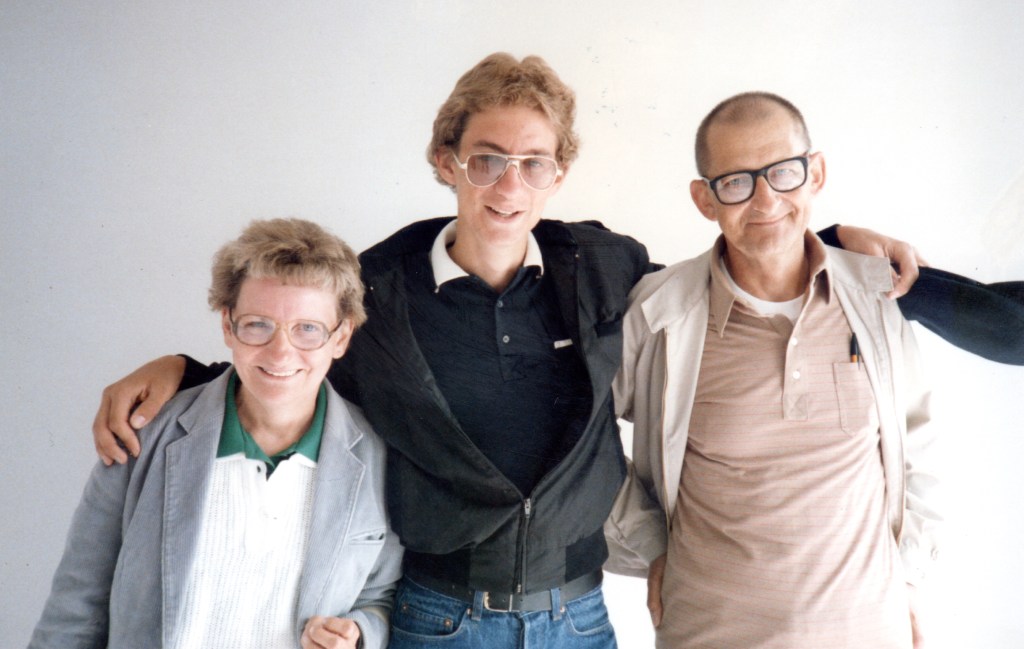
Flagstaff, Arizona

August 30, 1985

5:46 PM

“… and with one phone call, his future begins,” said Hal, setting his beer on the kitchen table. 

His wife, Marie, smiled at her son, Horace, as he spoke into the phone. 

“Mrs. Burke?  My name is Horace Singleman.  I’ll be your student teacher this year.  I’m calling to introduce myself and to find out if there’s anything special I should do, or bring, or… um… you know… think about for my first day.”

“Eloquent as ever,” whispered Marie.

“He’s nervous,” Hal whispered back.  “Give the boy a break.”

“Yes, ma’am.” Horace was getting control of himself.  “I’ll be sure to bring a lesson plan book, too.  Is there a particular type you recommend?”

Hal laughed.  “She’s not going to let him get by with that, is she Marie?”

Marie shook her head.  “He’s not close to ready to do his lesson plans in those little blocks.  He’ll need to…”

“Oh, yes, ma’am.  I understand.  So probably a wire notebook or…”

“Where should we take him for dinner?  Do you think La Fonda is enough or…”

“No.”  Hal shook his head.  “This is the day his life changes.  Let’s get the boy a steak.”  Hal and Marie had never been so proud.  Horace had never been more nervous.

Interstate 17

October 9, 2009

7:43 PM

Nervous.  That was the best explanation.  He was afraid he would fail his mother.  “But screw thy courage to the sticking place, and we’ll not fail.”  Maybe Lady Macbeth wasn’t the right person from whom to get emotional advice.  She was a murderous bitch.  On the other hand, Shakespeare often put his best advice in the mouths of his villains.  And I’m responsible for who I am.  Testing his memory, and finding his strength, Horace recited into the darkness:

No, no, no, no! Come, let’s away to prison:
We two alone will sing like birds i’ the cage:
When thou dost ask me blessing, I’ll kneel down,
And ask of thee forgiveness: so we’ll live,
And pray, and sing, and tell old tales, and laugh
At gilded butterflies, and hear poor rogues
Talk of court news; and we’ll talk with them too,
Who loses and who wins; who’s in, who’s out;
And take upon’s the mystery of things,
As if we were God’s spies: and we’ll wear out,
In a wall’d prison, packs and sects of great ones,
That ebb and flow by the moon.

Horace had printed that in appropriate script, and he had gotten it professionally framed for his Father.  It had been on the wall in Dad’s office for decades.  He knew Dad understood that they were God’s spies.  No one else ever asked why that was on the wall.  They just accepted that it was part of Horace and Dad.

And Horace had gotten through the whole thing, aloud, without crying.  He was getting stronger.  He would be all right.  He could help his Mom. 

Flagstaff, Arizona

October 3, 2009

8:18 AM

Horace gazed at his Father.  Hal was in and out of consciousness, and he was clearly restless.  He didn’t understand where he was.  He didn’t know what was happening. 

Marie set her hand gently on Horace’s shoulder.  “Why don’t you read him some poetry?  That soothes him.”

“Do you think he’ll understand?”

“Do you think it matters?”  His nephew, Sheldon’s son, Leonard, sat on the other side of the table, and he gave Horace an annoyed glare.

“Good point.”

And Horace read.  Hal didn’t seem aware of his surroundings, and yet, every few minutes, he would finish a line. 

“And I am two-and-twenty,

       And oh, ’tis true, ’tis true,” mumbled Hal as Horace read AE Houseman. 

Horace smiled at his father.  The things one remembers when one’s time is coming to a close.  Hal recited lines about a patient etherized upon a table, and then, with the slowest, most graceful movement, turned his head and looked at his son.  “Let us go and make our visit.”  He almost smiled, but his lips wouldn’t quite go that far before Hal was asleep again. 

Flagstaff, Arizona

October 9, 2009

8:12 PM

Horace pulled into his parents’ driveway.  This wasn’t the house in which he had grown up.  They’d sold that and moved into this much more easily maintained home in the Country Club.  They had been here for five years now, and every time Horace arrived he felt as though he were visiting a foreign country.  Tonight, it felt like an alien planet.  How could it be that he would go through that door without his father greeting him?

“Strength, Horace.  Your Mother needs your strength tonight.  Hold it together.  You’ve got this.  You’re going to be just fine.”

The room wasn’t dark, but it certainly wasn’t glowing with the light he was accustomed to finding when he walked in.  His eyes needed no time to adjust. 

Mom was sitting at the kitchen table.  Sheldon, Horace’s brother, was standing next to her, his hand on her shoulder. 

Hal was lying on what appeared to be almost a stretcher.  His eyes were closed.  The light was dim, and Horace kept waiting to see him take just one breath.  Horace took a deep one of his own, and went to his Mother to hug her.  She needed his strength; he would….

On the wall to the right of his mother was a cheap calendar with the Mona Lisa on the front.  And Horace lost all control of himself.  He crumpled like bad prose on cheap paper to his knees and began bawling uncontrollably.  His mother held him, but he couldn’t stop.

“He’s going to hyperventilate,” said Marie.

Sheldon got him a paper bag into which he told Horace to breathe.  Horace didn’t want to breathe. 

Flagstaff Funeral Home

October 21, 2009

3:47 PM

Horace looked out at the people.  There must have been a hundred of them.  It was standing room only.  And they were looking at him.  He hated that. 

He didn’t want to speak here today.  He and his brother had fought over the music Horace chose for their Father’s Memorial Video.  Horace just wanted to hide where no one would ever find him again, but… here he was.

He had been talking for about ten minutes now.  He had worked for days on what he would say, and he found himself resentful that his father wasn’t here to help him fix his prose.  It was important.  Dad had never let him down before, but now, when it mattered… he was nowhere to be found.  He wished these people would stop looking at him.  He looked down to his pages again.  He knew better.  He knew public speaking.  He’d been a teacher for more than 20 years.  He just couldn’t look at these people, and he buried himself in the safety of the printed word.  He read aloud.

“And so now you’re gone, and while some see no tragedy in your passing, I see little else.  I am grateful for the love I have for and get from all these people you gave me, but none of them, nor all of them combined, can ever give me what you did.  I have no one to check my work.  I have no one to explain to me what John Dewey meant about experience and education.  I have no one to ask me what movies he should bother watching.  I have no one with whom to argue about whether Fried Green Tomatoes belongs on the 100 Great Movies List.  And I have no one to tell me that sentence would have seemed less awkward if I ended it with a preposition.  And it just sucks.

“So, I know we have no Heaven for you.  I know that you simply are no more.  But, much as it would annoy you, I need to steal some other writers’ words now because they’re better than mine.  Yes, I know which of the people listening to this are thinking, “That’s not saying much,” and I would like to direct to those people the napkin I would normally being throwing at you, Dad, for such an insolent thought.  So, forgive me please, but remember that, “Good writers borrow from other writers; great writers steal from the outright.”

“So, “Let us go, then, you and I…”

“And would it have been worth it, after all,
After the cups, the marmalade, the tea,
Among the porcelain, among some talk of you and me,
Would it have been worthwhile,
To have bitten off the matter with a smile,
To have squeezed the universe into a ball
To roll it toward some overwhelming question,
To say: “I am Lazarus, come from the dead,
Come back to tell you all, I shall tell you all”—
If one, settling a pillow by her head,
  Should say: “That is not what I meant at all.
  That is not it, at all.”
 
And would it have been worth it, after all,
Would it have been worthwhile,
After the sunsets and the dooryards and the sprinkled streets,
After the novels, after the teacups, after the skirts that trail along the floor—
And this, and so much more?—
It is impossible to say just what I mean!
But as if a magic lantern threw the nerves in patterns on a screen:
Would it have been worth while
If one, settling a pillow or throwing off a shawl,
And turning toward the window, should say:
  “That is not it at all,
  That is not what I meant, at all.”

–TS Eliot, from “The Love Song of J. Alfred Prufrock

“When I think of your absence, I am forced, reluctantly, to admit that my mind goes somewhere you would loathe it for going.  “He’s really not dead.  As long as we remember him.” 

“You don’t really need Heaven, though, anyway.

I have sometimes dreamt, at least, that when the Day of Judgment dawns and the great conquerors and lawyers and statesmen come to receive their rewards–their crowns, their laurels, their names carved indelibly upon imperishable marble–the Almighty will turn to Peter and will say, not without a certain envy when He sees us coming with our books under our arms, “Look, these need no reward. We have nothing to give them here. They have loved reading.”

“So, I’ve written too much now already, forgetting that “brevity is the soul of wit.”  On the other hand, “I cried when I wrote this song; sue me if I play too long.”

“I’ll wind it up with just one more quotation.  “It is with a heavy heart that I take up my pen to write these the last words in which I shall ever record the singular gifts by which my …” father, Hal Singleman, “was distinguished.”  You are the one whom I will “…ever regard as the best and wisest man I have ever known.”

“I miss you.

Love,

Horace”
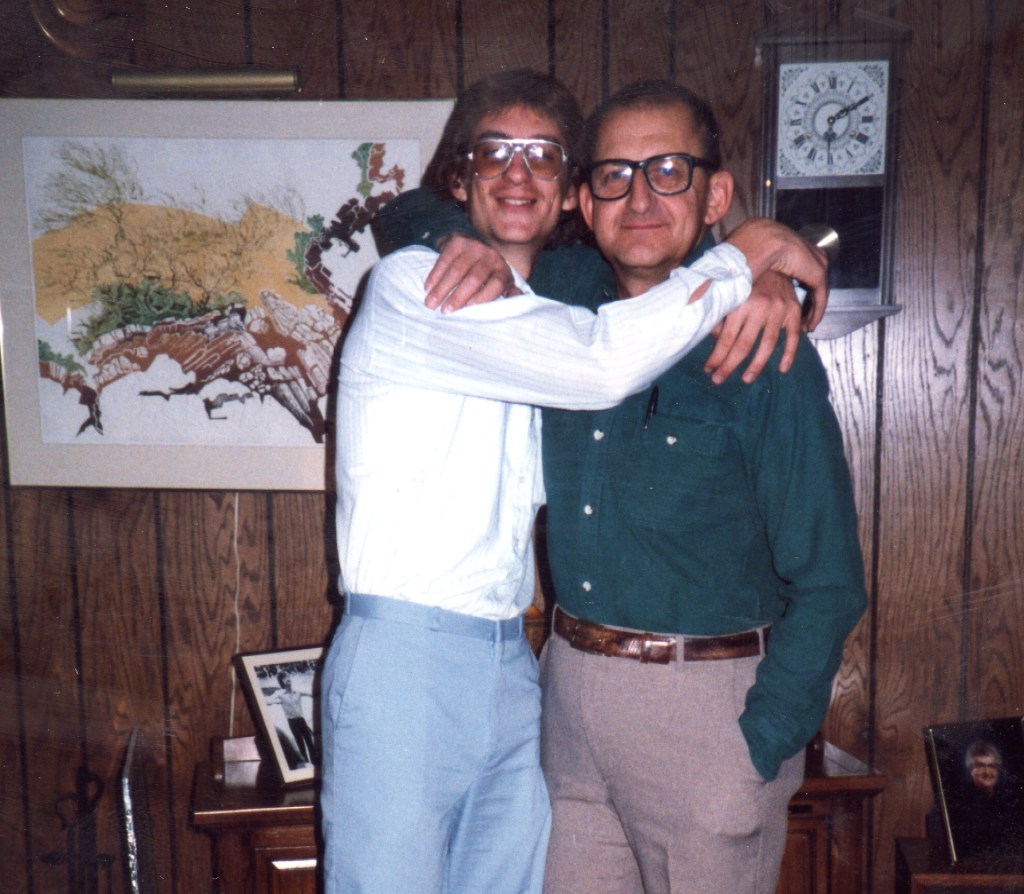
The Aging Existentialist: Seeing Myself from Someone Else’s Point of View

What do we mean by saying that existence precedes essence? We mean that man first of all exists, encounters himself, surges up in the world – and defines himself afterwards…

Jean Paul Sartre, Existentialism is a Humanism

I wrote an essay recently about being referred to as an Online Panhandler. I expressed that I don’t know whether I fit the definition of Panhandler, but I see nothing wrong in being one.

The essay is here, in case you would like to read it.

frededer.home.blog/2019/06/21/online-panhandler/

A good friend of mine left this comment.

…Regarding panhandling, “there, but for the grace of god, go I”. (Could substitute “rank good fortune” for “god”.) There too, but for the grace (of) god, goes your friend who passed judgment on you. You seem to feel the pain of the world and you don’t question the only sane response, which is compassion. You seem to share what little you have with others, and want to do more. You seem to draw your circle of inclusion far beyond your immediate environment. Your friend draws his/her circle of inclusion very close to himself, hoarding what he/she has, and condemning those who by choice, necessity, or circumstance find themselves in a very different place. On more than one occasion I believe that I have told you I think, although you and I have never met, that you are a good man (not perfect, but a good man). May I suggest that you write an essay/analysis of MY “judgment” of you? I think it might be a more challenging exercise, but one that might be quite illuminating. You don’t even need to post it, but by posting it you might get feedback that might also be illuminating for you. Take care Fred. I still think you are a good man.

Ross hardwick

To answer him requires a bit of philosophy. Not too much. Don’t worry.

I was first exposed to the idea of Existentialism when I was 15 years old. I had returned from Iowa, where I came perilously close to becoming a confirmed Lutheran, and my father, a confirmed atheist and Professor of Philosophy of Education, had me audit his class. I wasn’t old enough to get credit for it, but I paid attention. And, while Dad rejected Existentialism, as did one of my heroes, Charles Frankel, I found it seductive. Frankel called it cosmic despair. I suppose he was right, but I found much in it that I loved, not the least of which were most of Monty Python, Cool Hand Luke, Butch Cassidy and The Sundance Kid, and The Graduate. I also loved Sartre’s The Wall. (Long before Pink Floyd had any ideas on the subject.)

While there is much to reject in Existentialism, such as the idea that there can be no certainty, and, therefore every choice is a Leap in the Dark, (it’s really not… yes, anything can happen, but one has experiences upon which to rely for making choices. It’s possible the Sun won’t set tonight, but I’m proceeding on the assumption it will, and not to do so is foolish.), there is also one part that has stayed with me into my old age.

When you choose, you choose for Every Man.

When we say that man chooses himself, we do mean that every one of us must choose himself; but by that we also mean that in choosing for himself he chooses for all men. For in effect, of all the actions a man may take in order to create himself as he wills to be, there is not one which is not creative, at the same time, of an image of man such as he believes he ought to be. To choose between this or that is at the same time to affirm the value of that which is chosen; for we are unable ever to choose the worse. What we choose is always the better; and nothing can be better for us unless it is better for all.

Jean Paul Sartre, Existentialism is a humanism

When I make a choice, for myself, I try to ask what I would want anyone to do in my position. If I choose Cruelty, I am endorsing it. If I choose Kindness, I’m advocating we all make that choice. To say I believe in Kindness is meaningless if it doesn’t influence my behavior.

My irritation with many Christians is that the best of their beliefs do nothing to guide their behavior. They use the bible as a weapon, and a cause for hatred. I don’t really believe that was Jesus’s intention. To quote from Harper Lee, “You are too young to understand it … but sometimes the Bible in the hand of one man is worse than a whiskey bottle in the hand of – oh, of your father.” – Miss Maudie

I know Christians whose beliefs guide them toward Love, Compassion, and Kindness. These are people I like. I may disagree with the path they chose to arrive there, but I like where they’re standing, and that’s what really matters.

So, what does it mean to be Fred, from the point of view of someone outside of Fred, like my friend, Ross, who is quoted above? He observes my penchant for Kindness and Compassion, and he finds them admirable. I see them as the only reasonable default position. I try to be what I think all men should be, but I have no doubt I fail from time to time.

I openly discuss both my Kindness and my Poverty. They are parts of who I am. They are parts over which I feel no shame.

I don’t generally discuss the parts of my character of which I’m ashamed. Do you? But, I suppose it’s important to be as honest about my flaws as I am my shining palace built upon the sand. What are they?

  • I should bathe more often than I do. A shower is out of the question for me, because it’s not a question of if, but when, I am going to fall and hurt myself. So, I take baths when it’s essential, but not with nearly the frequency I should. If you saw me when I was sitting at the computer writing, I would look mostly homeless. I could change this about myself, but the advantage of being alone is that I have no need to concern myself with the opinions of others about this. The fact is you can’t see me. My lack of hygiene is doing nothing to hurt you.
  • I think many things about which I’m not proud. I have all sorts of ideas and fantasies and dreams that are entirely inappropriate. On the other hand, those are mine, and, as it turns out, I may think what I wish. You’re not allowed to attack me for my thoughts. My words and actions are open for discussion. My thoughts are my own.
  • Though I believe Trust is the basis of every relationship, I lie sometimes. I loathe that in myself. And, sometimes, it is beyond my ability to control. That, however, doesn’t excuse it. I’m endorsing lying in everyone, and I’m eroding the Trust that makes society work. I haven’t decided, yet, what to do about it.
  • I rely too much on the Kindness of Relative Strangers. I should be able to support myself, now, but if I were on my own, I would be done. I don’t make enough to live alone. I have no retirement left, so I will work for what remains of my life. I’m not proud of my inability to support myself, but it’s a part of who I am, and to deny it is to lose a part of my identity.

That pretty much makes up my faults. I’m sure others find me arrogant, or think that I’m too much of a Grammar Nazi, or that I am selfish. I’m sure others could add hundreds of items to the list. Those, however, are the ones of which I’m most acutely aware.

But those who see me as Kind and Compassionate are seeing the parts of me I like best, and that I try to make my defining characteristics. I’m sure I’ve mentioned it elsewhere, but you’d be surprised how few people have read all 44 of my posts. So, it bears repeating.

When I was in High School, my AP English teacher debated Shakespeare with me. She was wrong, and I was right, but that’s beside the point. (I’m kidding. She was brilliant, even if she didn’t love Hamlet enough.) One of the things we discussed in her class was Marc Antony’s words about Brutus.

This was the noblest Roman of them all.
All the conspirators save only he
Did that they did in envy of great Caesar.
He only in a general honest thought
And common good to all, made one of them.
His life was gentle, and the elements
So mixed in him that Nature might stand up
And say to all the world, “This was a man.”

Shakespeare, Julius Caesar

I’ve always been slightly suicidal. I loved the way Brutus died. “Great Caesar, now be still. I killed not thee with half so good a will.” Beautiful!

And from the time Mrs. Julien brought it up to me, I decided I wanted Marc Antony to be able to visit me, in the final five minutes of my life, and say about me what he said about Brutus. He has to know everything I’ve done from the moment I was a fertilized egg up until his arrival, and he has to see the elements mixed in me such that he could say, honestly and without equivocation, This was a man.

I would like to be Atticus Finch. I’d like to be Hemingway’s Santiago. I’d like to be Capt. Kirk. I’d like to be my Father, who was a mixture of all those men. He would be pissed about the Capt. Kirk, but that’s all right. He had Kirk’s ability to reason morally. He had Kirk’s courage.

I can’t be any of those men. I have to be me. And when you’re old, diabetic as hell, broken, broke, and more than normally unattractive, you would be a fool to reject someone for being different from you. I will reject someone for behaviors I can’t tolerate: Cruelty, Insensitivity, and Unwarranted Selfishness are on the list. For an explanation of Unwarranted Selfishness, you can read this…

https://frededer.home.blog/2019/04/02/unwarranted-selfishness/

But someone who is a good person is a good person even if their beliefs differ from mine. She’s still a good person if her sexuality differs from mine, or if his politics differ from mine, or if his taste in music is so different from mine that he doesn’t even like The Beatles. (Although, to be fair, I’m going to have to have a LONG conversation to figure out what’s wrong with him!) If you’re a good person, I’m proud to call you my friend. How you got there is irrelevant to me.

And now I think of Kermit.

He tells me it’s not easy being green. And, I understand. I’m much like him. I don’t stand out. I’m not colorful. I’m not attractive. I’m not wealthy. I’m not strong. I’m not capable of a lot of things. But… this is who I am. And I’m okay with being this guy. I think the world still needs a Fred. I can handle that part.

I suspect the world needs you, too, but I don’t know, yet, exactly why. I hope you can find out and tell the rest of us.

The Path


I shall be telling this with a sigh
Somewhere ages and ages hence:
Two roads diverged in a wood, and I—
I took the one less traveled by,
And that has made all the difference.

Robert Frost

A few days ago, the first principal for whom I ever taught found me on Facebook, and we began corresponding a bit. When I met her, I was hardly a teacher. I was filled with Idealism, but I had none of the skills that experience brings. She nurtured the Idealism, and she helped me to get the skills that finally made me a truly great teacher.

This week she asked me this:

“Can I ask what [possessed] you to choose the path you chose?”

And, suddenly, I had to stop. I have never, in all my years, really thought about this. I’m a big fan of Socrates, who told me both, “Know thyself,” and “…the unexamined life is not worth living.” And I have tried to keep both of those ideas in mind, and to follow them to the best of my ability. But, one of the biggest parts of my life has been left unexamined for decades. I don’t know that the examination is going to yield the results I want, but this is my effort to answer her question.

I suppose “if you really want to hear about it…” I would have to go back to April 6, 1967, when I was not yet 5 years old. That was when Captain Kirk told Edith Keeler that the three words “Let me help” were more important even than I love you: “A hundred years or so from now, a famous novelist will write a classic using that theme. He’ll recommend those three words, even over I love you.”

No, I wasn’t a philosophical genius at age 4. I’m not Salinger’s Teddy. But, I knew there was something important there.

My parents were teachers. My parents helped. I believed in helping before I arrived at my first day of Kindergarten.

When I was little, I wanted to be Captain Kirk, Batman, and, from time to time, Mighty Mouse. There seems to be a theme within those folks.

When I was, perhaps, 7 years old, Dad gave me a Show ‘N Tell record player / slide show projector. The first show I ever watched on it was Hamlet. And I thought it was the coolest thing I had ever seen.

If we put all those elements together, perhaps we can see what motivated me to teach. I wanted to help. I wanted to be heroic. When I was old enough to begin to understand the idea of What Do You Want to Be When You Grow Up, I saw To Kill A Mockingbird. I also read the book. And, of course, I wanted to be Atticus Finch. It seemed for quite a few years that I would become a lawyer. Starship Captain and super hero were not professions that were widely available to adults in the 1960s.

My sister was a babysitter, rather frequently, when I was a child. She could make a little extra money in her entrepreneurial endeavors if she brought me with her. I was good at playing with little kids. Even then, I told them stories that I made up off the top of my head, just as my Dad did with me when I was little. He would ask the three of us what characters needed to be in a story. My brother insisted on Popeye, who I liked, too, and later he moved up to Winston Churchill, which made for some truly bizarre stories, since I, obviously had to have Captain Kirk or Batman, and my sister seemed to have an affinity for either Cinderella or Snow White. I challenge any writer to invent anything resembling a coherent story with that cast of characters. But… my Dad could do it. I miss him so much.

When I got older, and I wanted to be The Six Million Dollar Man, I would write plays my friends and I would perform in my garage. We did a great Frankenstein piece once because my friend, Tom, had figured out how to do Monster makeup.

I created my own cardboard version of the Bridge of the Enterprise in that same garage. I had a flashlight connected to a hanger that came through the toy pool table to which I had lost all of the equipment years earlier. I could aim the flashlight at different ships I made out of cardboard and stuck on the screen I made out of masking tape. There was a button on the pool table I could press to turn the flashlight on. I could fire phasers at my targets. It was incredibly cool.

Perhaps I should have been an engineer? Lawyer? As it turned out, Engineering required both more mathematical ability and physical dexterity than I would ever possess. Neither my father nor I were ever much good at physical tasks. My mother suspects that, had Special Education been as regulated, understood, and funded as it is today, I would have been diagnosed with something, but she never said what. My roommates suspect Asperger’s. They may be right. I honestly don’t know.

What did it turn out, from all this, that I could do well? The lawyer in me knew how to talk to people. I made pretty good arguments. The Starship Captain wanted a crew. The Writer wanted to see his plays performed. The hero in me wanted to help. It turned out, I found, one needed little green pieces of paper in order to survive on this planet in the 20th and 21st Centuries. Teaching would fulfill most of my desires, and it would earn me a few of those dollars that seem for many to be the mark of my value.

I became a teacher. Simple.

Except, that’s not REALLY what my principal was asking, I don’t think. I think she was asking why I quit teaching, and why I chose poverty and writing.

That was also about my Ideals.

When I began teaching, I was hired because of my Ideals. My principal wanted a teacher who wanted to go beyond the Basal Reader. She wanted creativity, ideas, and engagement. She wanted what might today be called Progressive Education. I was encouraged to stretch myself and the minds of my students. Everything was ripe for me to grow. And I did.

I became a very good teacher. I have known few who were better than I was. I’ve known quite a few who were as good, and more than I would like to admit who were not. I developed a highly functional Token Economy that, by the end of my career, included bank accounts run by students on computers. I had 4th Graders doing Hamlet.

I was living the life I wanted. I was proud of who I was, what I was doing, and what I was producing. I was as happy as I could be. I made a difference.

I wrote my own musicals for students, and I learned to record their vocals so they could sing with themselves over the vocals on the original tracks. The plays were as professional as any Elementary School was likely ever to do. The kids felt the kind of pride that can be gained only by getting a standing ovation. I don’t care whether it’s in the library in your school or at Carnegie Hall. There is a glow that comes with it that can’t be found by getting an A+ on your report card.

One of my students had been terrified of getting on the stage, but he memorized ALL of Hamlet’s Soliloquy when he was in 6th Grade. And when he did it on stage, he nailed it. And the audience of parents and students responded. Today, he makes a living producing and acting in his own plays. Was that me? I don’t know. I know I’m proud of him, though.

The kindest thing anyone ever said to me was said by one of my students when I was in my sixth or seventh year. She had difficulty reading, but when she graduated from high school, she was selected to give one of the speeches because of her many great accomplishments. And she insisted that my principal and I come to the ceremony. We went.

In her speech, she said, “I had two teachers who really believed in me.” She named her Special Ed teacher, and me. “Mr. Eder said if I wanted to play Ophelia, I absolutely could do it. And because of him I can quote Shakespeare today. Really,” she said. “Ask me anything.” And then she sought my eyes in the crowd, and she said, “To be or not to be, Mr. Eder? I choose to be.” And I wept visibly. Thirty years later, my eyes still tear up at the memory.

And that began to change. It changed when I changed principals. When my first principal retired, she was replaced by a new one, who once did an evaluation of a brilliant lesson I had taught in Hamlet, in which I hit every possible goal on any evaluation, by saying, “Let’s talk about what you didn’t do.” I hadn’t used the correct materials, you see. Hamlet wasn’t approved by the District for Elementary School. I should have been using the basal reader. And, thus began the decline of my career.

I fought, of course, valiantly. Capt. Kirk, and later Hemingway’s Santiago, taught me that. And for many years, I was able to continue to teach in ways that made me proud. I was forever fighting principals and district committees and anyone else who was obsessed with test scores, but, I won most of those battles. My students were excited. Their parents loved what we were doing. I still felt proud.

And a few years after my first principal retired, I attended yet another end of the year waste of time with the entire district. They had asked me to create a video… an actual video, on video tape… no cell phones existed yet… combining pictures and music that celebrated the district. I did it for free, and I made it precisely the way they wanted it. And they showed it before the program started. Instead of having the entire district watch the Art I tried to create (on which I had worked for many hours, and of which I was more than a little proud), they used it as Elevator Music. My ego bruised, my wife and I left. There were more than 1,300 people there. No one would notice.

Except, they did notice. When they handed out the award for Hesperia Unified School District Teacher of The Year, I wasn’t there to accept it. And they had brought my first principal out of retirement to present it. Oops.

My career reached its summit while I was teaching in Maine with a group of the most creative people I’ve ever known. We were using professional theaters for my musicals now. We were creating units that had students traveling back in time, interviewing people from the Renaissance, mapping their trip from one side of Europe to the other, creating a log to chronicle their adventures, creating physical models of their imaginary modes of transportation, and solving the puzzle to return a stolen item to its original user, thus saving History as we know it. They were reflecting on their own learning with daily reports of themselves and the other members of their group.

Students were producing their own magazines by buying and selling articles and pictures from and to each other. Their writing was improved not because I insisted it be better, but because it needed to be in order to sell it. They challenged themselves and each other. My job was just to let them know when they had made their articles’ language mechanics perfect. I would stamp the article, and its value would triple on the market.

I could go on and on, but I feel like I’ve already done that. The point is, I was teaching well, I was excited, I was making a difference, and I was honoring the three most important words: “Let me help.”

By the time I quit, they had removed all of it. I was strictly bound to district materials. One of my principals actually shut down my Drama Club. It wasn’t just that he cut funding. I could have raised the money myself. He decided it wouldn’t be allowed at all anymore. Honestly, it was making me too popular with students and parents, and he and I had been at war for a couple of years. He had to remove as much of my power as he could, and he managed it. I changed schools, and it wasn’t long before there was no more fun to be had in my class.

We had to “track data.” We had to have our PDSA wall up to date. We had to have “artifacts” on our “My Learning Plan” website to prove we were good teachers. We had to teach by a set of arbitrary rules, and the scores students made on tests were of paramount importance. Everything that meant teaching to me had evaporated. I couldn’t do it anymore. My students were beginning to learn the only reason anyone reads is so they can pass a mind numbingly dull test on a computer that proves almost nothing, assuming, of course, we can get the computer up and running so the students can take the test.

My once glowing evaluations had become recitations of complaints that I wasn’t a “team player,” and I wasn’t doing all the things that they now believed were vital to teaching.

By this time, after having been divorced twice, borrowing money every month to make the bills, getting roommates who were convicted felons in an effort to avoid eviction, and surviving the Death of my Father and watching the loss of my Mother’s mind, my depression was at a place that my psychiatrist pulled me out of work because he was afraid I was going to hurt myself. At the end of the 2016 school year, I resigned, pulled my retirement, and lived well for several months before I plunged permanently into poverty.

My diabetes kicked into high gear. I was hospitalized a dozen times in the course of 2 years, at least twice when I should have been dead save for the intervention of other people.

I couldn’t teach another day of Elementary School even if I wanted to. I could still teach Defensive Driving, so I got myself re-certified (I lost my certification for a while when I got a photo radar citation), and started making what I could. Prior to that I worked at trying to sell DirecTV to unsuspecting old ladies over the phone. I loathed that. It was the opposite of everything in which I believed. Worse, I was good at it.

I have a couple of roommates now who help take care of me. I make almost, but not quite, enough to survive. I’m on Food Stamps and state Health Insurance. But, I spend more time writing, which, let’s face it, is what I think I really wanted to do in the first place, and I limit my social life to Facebook. I have no retirement. I have no means of ever quitting work again. I hope, one day, I might be able to get disability, and maybe it will be enough to keep me alive.

For all the poverty and poor health, I think I’m actually happier now. I like myself again. I’m still not Batman, and I have retired from the Bridge of the Enterprise. Now, I’m a man who is cuddled by cats, but my body is shot. That’s fine, though, because other than containing my consciousness, there’s really almost nothing else I want to do with it. I’m a guy who sits in the backyard smoking while I rewrite my work with blue inked Uniball pen in my left hand. I’m someone who shares too much of his personal life with strangers… for Some People. I’m too private for the liking of Other People. For Some I need to be more concise. For Others I need to go into greater detail. But, this is who I’ve become now. In short, I think I’m Fred now. I like this guy.